Why flare gas recovery matters

Routine flaring results in lost energy, increased emissions, and growing regulatory pressure. At the same time, flare gas streams often present challenging operating conditions, including low suction pressure, fluctuating flow rates, and varying gas compositions.

Implementing an effective flare gas recovery system allows operators to capture and reuse valuable hydrocarbons that would otherwise be burned in a flare stack.

GARO flare gas recovery systems are designed for continuous operation in demanding refinery, petrochemical, and industrial environments. Using robust liquid ring compressors, each flare gas recovery unit can efficiently manage low inlet pressures and changing gas conditions while providing reliable performance and long equipment life.

Recovered gas can be reused as fuel, sent for further processing, or utilized for power generation, transforming waste emissions into valuable resources.

GARO flare gas recovery systems are designed to operate continuously under demanding industrial conditions. Using liquid ring compressors, the system efficiently handles low inlet pressures and fluctuating gas composition while ensuring stable performance and long service life.

Recovered gas can be reused as fuel, sent for further processing, or utilized for power generation—turning emissions into value.

Garo Flare Gas Recovery

How a flare gas recovery system works

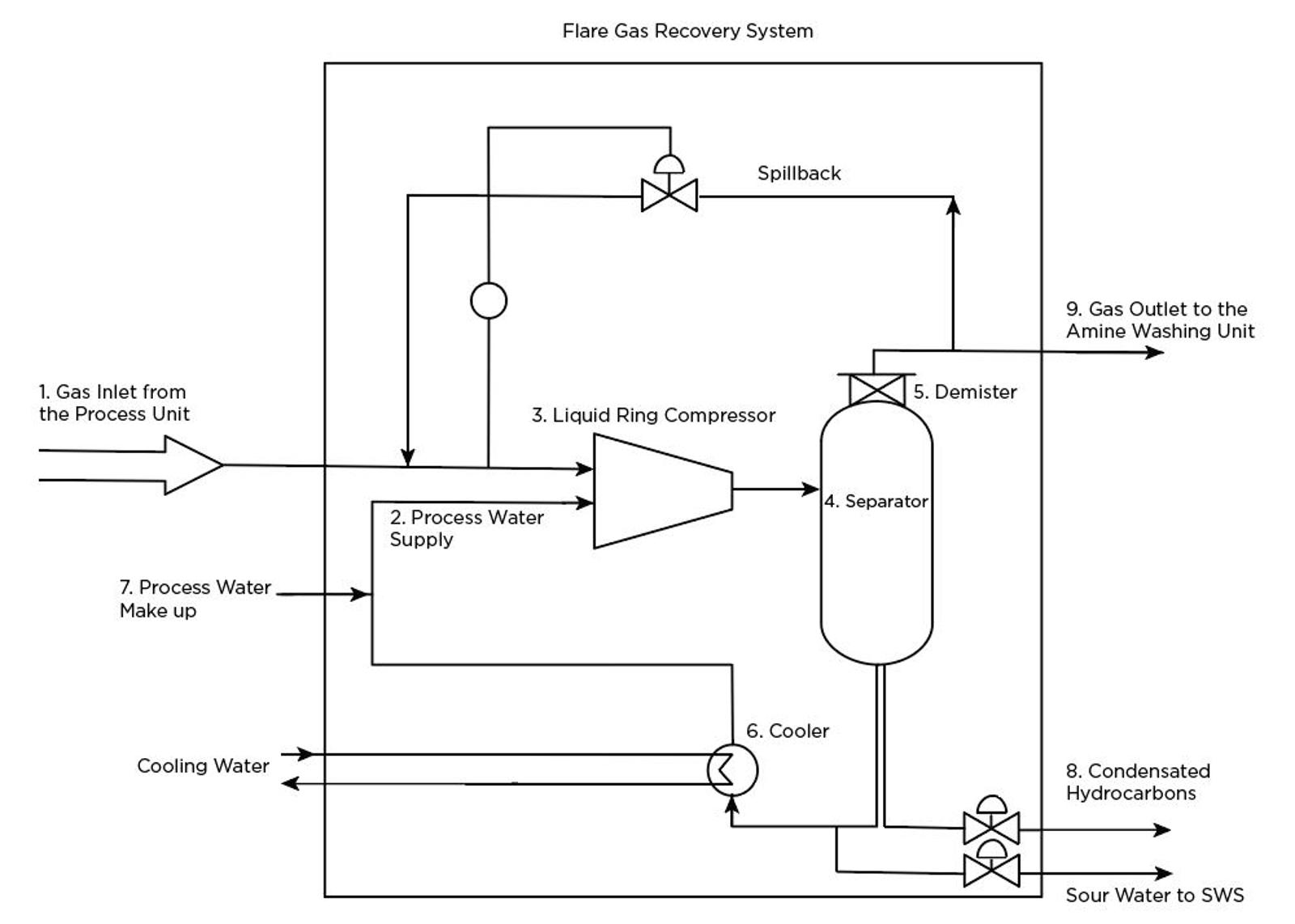
A typical flare gas recovery system captures gas that would normally be sent to the flare and compresses it for reuse within the facility. The process below illustrates how a GARO flare gas recovery unit operates.
  • The gas (1) coming from the flare Process Unit enters the Liquid Ring Compressor (2) along with the process water (3).
  • After the compression phase, the gas, water and hydrocarbon mixture enters the separator (4) where the three elements are parted: the gas passes through a demister (5) to have minimum water and leaves the vessel from the top, while condensed hydrocarbons and water are separated by gravity due to lower gas speed. 
  • The water is pushed back to the compressor, after being cooled again by a cooler (6). 
  • Moreover, a continuous process water make up line (7) in the compressor suction line is provided to ensure a continuous water ring in the compressor. 
  • The condensed hydrocarbons are discarded (8).
  • The gas exiting the separator finally heads to the Flare gas Amine Washing Unit (9) where it is amine treated to remove H2S. 
  • The treated gas is then pushed to the Fuel Gas header to be used as fuel.
火炬气回收系统工艺方案

Discover the GARO Flare Gas Recovery System Brochure

Flare Gas Brochure Cover image

Why liquid ring compressors are ideal for flare gas

GARO liquid ring compressors are the core technology behind every flare gas recovery unit, providing safe and reliable compression of potentially explosive, corrosive, and contaminated gases. Liquid ring technology delivers near-isothermal compression, resulting in lower operating temperatures and dependable performance across a wide range of gas compositions.

As a critical component of a modern flare gas recovery system, liquid ring compressors can handle fluctuating gas flows, low suction pressures, and varying molecular weights while maintaining stable operation. They can also operate with different seal liquids, providing additional flexibility when processing toxic or corrosive gas streams.

Reliable operation at very low suction pressures

Reliable operation at very low suction pressures

Tolerant to fluctuating gas flow and composition

Tolerant to fluctuating gas flow and composition

Continuous-duty performance with minimal maintenance

Continuous-duty performance with minimal maintenance

Lower life-cycle costs compared to alternative technologies[

Lower life-cycle costs compared to alternative technologies

FGR System provides several environmental and economic benefits to refineries, such as:

  • Lower Emissions: Recovering hydrocarbons through a flare gas recovery system reduces the volume of gas flared and helps lower emissions of harmful compounds such as hydrogen sulfide (H₂S) and greenhouse gases.
  • Reduced Operating Costs:A flare gas recovery unit allows operators to capture and reuse valuable hydrocarbons as fuel gas, reducing fuel purchases and improving overall plant efficiency.
  • Social & Environmental Responsibility: By implementing a flare gas recovery solution, facilities can support sustainability goals, meet environmental regulations, and demonstrate commitment to responsible operations.

Typical applications

Flare Gas Recovery (FGRS)

Flare Gas Recovery Systems (FGRS)

Vapor & VOC Recovery (VRU / FPSO)

Vapor & VOC Recovery (VRU / FPSO)

Vent and Off Gas Compression

Vent and Off Gas Compression

Onshore and Offshore Applications

Onshore and Offshore Applications

Turn Flare Gas into Value with the Right Flare Gas Recovery System

Whether you need a new flare gas recovery system, an upgrade to an existing installation, or support selecting the right flare gas recovery unit, GARO experts can help design the optimal solution for your process requirements.